
Most Businesses Are Still Using AI Like It's 2023
The biggest opportunity isn't writing better prompts. It's building Custom GPTs that remember how your business works
A while ago, I realised I was repeating the same routine every time I opened ChatGPT.
I’d explain my business.
Describe my audience.
Outline my writing style.
Paste examples.
Then I’d finally ask the question I actually wanted answered.
The results were often good. That wasn’t the issue.
The problem was that I kept rebuilding the same foundation every time I started a new conversation.
That’s when something clicked.
Most businesses still use AI as a conversation.
The businesses getting the greatest value use AI as a system.
That’s a much bigger shift than many people realise.
ChatGPT Is Helpful. Custom GPTs Are Consistent.
There’s nothing wrong with using ChatGPT to answer questions, write emails, or generate ideas. Millions of people do it every day.
The downside is that every conversation begins with a blank slate.
Your writing style is gone.
Your company policies are gone.
Your product knowledge is gone.
Everything that makes your business unique has to be explained again.
That isn’t a weakness in AI.
It’s a workflow problem.
Businesses have relied on documented processes for decades because consistency matters. Marketing teams follow brand guidelines. Sales teams use proven approaches. Customer support teams work from approved documentation.
AI should work the same way.
A Custom GPT lets you capture those processes so they don’t have to be recreated every day.
What Is a Custom GPT?
The name sounds technical, but the idea is simple.
A Custom GPT is a version of ChatGPT that’s been given a specific role, clear instructions, and access to the information it needs.
Instead of acting as a general assistant, it becomes a specialist.
You might create one that writes blog posts in your brand voice.
Another could answer customer questions using your own policies.
Another might produce proposals using the format you’ve refined over the years.
You’re not replacing your expertise.
You’re packaging it into a reusable system.
That’s why comparing a Custom GPT with a normal ChatGPT conversation misses the point.
A standard chat answers today’s question.
A Custom GPT improves tomorrow’s workflow.
Think Less About Prompts, More About Processes
Many people spend hours collecting prompts.
I’ve done it myself.
Sooner or later you realise the prompt isn’t the valuable part.
The process is.
Every successful business relies on repeatable methods.
You already have ways of writing emails, qualifying customers, creating products, and solving problems.
Those methods are valuable business assets.
A Custom GPT allows you to use them repeatedly without copying the same instructions into every conversation.
Instead of asking, “What should I ask ChatGPT today?”
Start asking, “Which recurring task should I stop rebuilding?”
That’s where the biggest gains usually appear.
Where Businesses Are Already Saving Time
Once you stop viewing AI as a chatbot, opportunities become obvious.
Marketing teams can draft articles, newsletters, and product descriptions that follow established brand guidelines.
Customer support teams can answer routine questions using approved documentation.
Sales teams can prepare proposals and follow-up emails using consistent formats.
Training becomes easier because new employees can ask questions based on your internal knowledge instead of searching through folders of documents.
Research tasks such as summarising reports or organising information can also be completed much faster.
Major companies are already moving in this direction.
Canva has built AI into its creative tools.
Shopify uses AI to help merchants create product descriptions and manage parts of their businesses.
The common goal isn’t replacing people.
It’s reducing repetitive work.
Small Businesses Have the Biggest Opportunity
Many people assume AI gives large companies the biggest advantage.
I think small businesses often have more to gain.
Large organisations move slowly.
Approvals take time.
Systems have to fit together.
A small business can identify a problem in the morning, build a Custom GPT in the afternoon, and start improving it immediately.
There’s another advantage.
Most of the knowledge sits with one person, the owner.
You know how customers think.
You know what makes a good proposal.
You know which emails generate replies.
Unfortunately, that knowledge often stays inside your head.
A Custom GPT captures it before it becomes a bottleneck.
Instead of relying on memory, your business starts relying on documented processes.
That makes your work more consistent and easier to delegate.
Start Small
One mistake people make is trying to build one GPT that does everything.
Don’t.
The best Custom GPTs solve one recurring problem well.
Choose a task you repeat regularly.
Document how you complete it.
Include your preferred structure, writing style, rules, and examples.
Upload any supporting documents such as FAQs, templates, or product information.
Then start testing.
Your first version won’t be perfect.
That’s expected.
Review the output, improve the instructions, and keep refining.
Think of it as training a new employee.
Each improvement makes future conversations better.
AI Is Becoming About Systems
People often ask which AI tool is best.
I think there’s a better question.
“What knowledge does my business keep recreating?”
Every repeated explanation.
Every copied email.
Every familiar process.
Those small tasks consume hours over time.
A Custom GPT doesn’t remove all your work.
It removes much of the repeated setup work that slows you down.
That’s where the real value lies.
Businesses that continue using AI as a search engine will still benefit.
Businesses that build systems around their knowledge will benefit much more.
You don’t need dozens of GPTs.
You don’t need to understand programming.
Start there.
The time you save over the next year may surprise you.
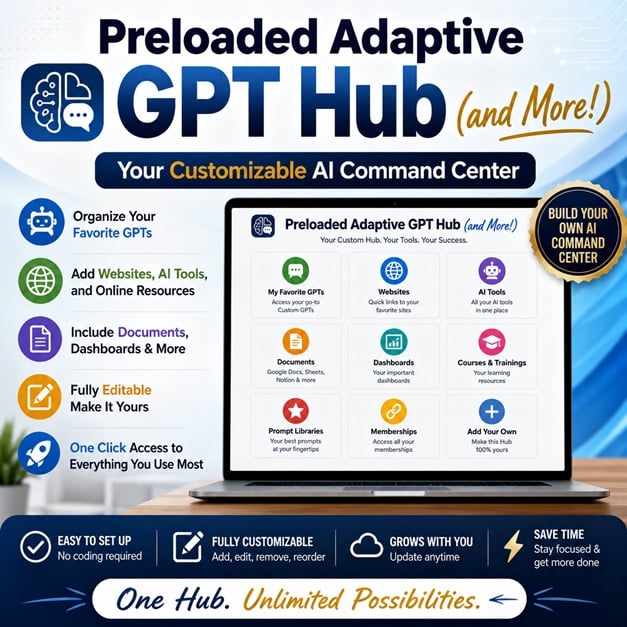
Recommended Resource: The GPT Hub
GPTs Scattered Everywhere?
Stop Hunting for Your Favorite AI Tools.
Find Them Easily with The GPT Hub (includes 4 valuable GPTs):